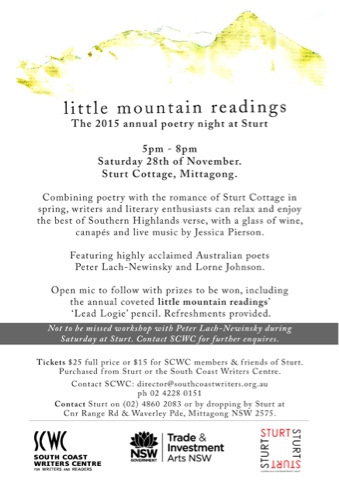
Peter Lach-Newinsky is a fabulous poet. I have been in awe of the strong voice that is conveyed through his poetry and I can't wait to attend this poetry workshop on the 28th of November, 10am-1pm, at the beautiful Sturt Cottage.
To be a poet one needs the six P’s – the pencil, the paper, the perception, the passion, the persistence and the unshakable persuasion that the poem is in fact possible and attainable. - Grace Perry
Monday, September 21, 2015
Tuesday, September 8, 2015
little mountain readings 2015
Can't wait for another great little mountain readings!
This year Peter Lach-Newinsky and Lorne Johnson are our feature poets. As always there will be drinks, canapés, live music, book sales and an open mic.
This year's event is on the 28th of November, from 5-8pm, at Sturt, Mittagong.
Friday, January 2, 2015
A New Year and finally taking action on some challenges I've been wanting to do...
The New Year, a time for new reading and writing challenges...
- I have challenged myself to tweet a poem or line of poetry everyday @Rhi1988
- I have set a reading challenge on GoodReads - 50 books read in 2015
- I am also taking on the 2015 Australian Women Writers Challenge, which was set up to help overcome gender bias in the reviewing of books by Australian women. The challenge encourages avid readers and book bloggers, male and female, Australian and non-Australian, to read and review books by Australian women throughout the year. My aim is to read 6 books by Australian women – reviewing at least 4. Find out more about this challenge at
@Auswomenwriters #aww2015 http://australianwomenwriters.com
Sunday, October 26, 2014
Little Mountain Readings - Poetry Workshop
Saturday 15
November, 10.00 am–1.00 pm –
Ron Pretty will lead a poetry workshop,
Drafting: A Creative Process, at Sturt Cottage, Mittagong.
Participants will explore ways of developing a first draft into a fully crafted poem. The
workshop will explore the creative aspects of the process, including line breaks, language, imagery and structure.
Participants are asked to bring several of their current poems.
Fees (including tickets for the Little Mountain Readings in the
afternoon) are $85 full fees, $65 Friends of Sturt and SCWC members and $45 for under 18s.
Bookings essential on (02) 4860 2083 (Sturt Cottage). Information
on (02) 4228 0151(South Coast Writers’ Centre).
Friday, October 24, 2014
Little Mountain Readings 2014
Bring along your poems! Open mic with book prizes and the inaugural lead logie (LMR pencil) to be won.
Refreshments provided.
Bookings from the South Coast Writers’ Centre at director@southcoastwriters.org.au or from Sturt Cottage on (02) 4860 2083. $25/$15 (SCWC members and Friends of Sturt Cottage).
Wednesday, October 8, 2014
Books I have read - Navigation by Judy Johnson
A trade with my dad (we both had accidentally purchased books we already owned) rewarded me with a copy of Navigation by Judy Johnson.The blurb states that: "Navigation contains poems that are short, sharp pieces drawn from her abiding concerns with family, death, and love". As I sat at Central train station reading her explorations of these human concerns I felt that the bustling of life around me was the ideal setting to get lost in Johnson's words.
'Paper Dolls' is an honest scene from a childhood, exploring the innocence of youth and the conflict that can occur in adult relationships. I remember paper dolls and paper bikinis from my own childhood, the concentration and care needed to pop all of the pieces out and neatly fold the tags so that the 2D figures could be as glamorous as their glossy haired barbie doll cousins. Through her description of the attention given to these dolls Johnson explores the child's emotional response to the sound of fighting from the next room:
I push hard on the perforations.
She comes away in two pieces.
Johnson writes poignant images, such as: "I remember the ground / dog-nose damp beneath my feet", capturing the imagination of a child and the sometimes uncomfortable relationship between father and daughter in her poem 'A Month Before my Father Died'.
A poem that resonates with me is 'At the Temple of Sisters'. Someone close to me has been recently diagnosed with cancer and in this poem Johnson describes the cruelness of the disease:
But snares and exorcisms don't work.
There is nothing to offer your cancer
that it doesn't already have.
Johnson's longer poems in this collection are historical narratives of whalers, a whaler's wife and the Tuniit people of the Antarctic. Here is a harrowing description of doing the laundry on a whaling vessel from her long poem 'A Whaler's Wife at Sea':
...After they are dragged
back in I sew the body-eaten ghosts
of drowned sailors with thick twine
onto the strung line.
Warrick Wynne has written a review of Navigation which can be found here. He discusses the diversity of poems and the four parts within the collection, stating that: "[he] found it a little difficult to find the centre of it all, or something like the true voice, if indeed that’s the quest. The book is diverse and moves from the past to the present and back again fluently and is as comfortable with the story as the lyrical moment". For me the centre of the collection is this theme of family, death and love.
I agree with Wynne that the first section, 'Ties', contains the strongest poems of the collection. These poems delve into difficult and sometimes uncomfortable emotions and display an impressive control of language. 'Cannas' is a perfect example of Johnson's rich imagery and description of the external world, alongside an exploration of our 'inner worlds' that Peter Boyle has praised her for. She captures the flowers, their "Garfield-orange, / fresh-wound red, / lemon-spread yellow" colouring and their "elastic javelin" stems. At the same time, she writes of the complexities of coping with cancer, "terminal clusters" that "flows like heredity /through my dreams".
To purchase a copy of Navigation visit 5 Island Press here.
Johnson's most recent book Stone Scar Air Water can be purchased here.
Monday, September 29, 2014
Journals I have read - Australian Poetry Journal: #concrete vol3, no2
This issue of Austalian Poetry's journal is all about concrete poetry. Bronwyn Lea's introduction to this edition, the last edition of the journal that she will be editing, provides some great insight into the value of concrete poetry: "[t]he tiny components of written language are rendered almost invisible to us in our race to extract all-important 'meaning'. But in concrete poetry, language stands in our way: letters and words fight - through scale or arrangement - for visibility" (2014). I think that all poetry insists that we pay attention to each 'tiny component' of language, for in poetry each word and punctuation mark is selected for a particular reason and concrete poetry is not the only form of poetry that explores the aesthetics of words and letters. However, the way that "concrete poetry deals with the relation between the visible form and the intellectual substance of words", as Robert Simanowski puts it, is indeed intriguing (Lea 2014).
As interesting as the theory behind concrete poetry is it is not my favourite form of poetry. The experimentation in the aesthetics of language is sometimes beautiful and sometimes interesting, but I often struggle to understand the meaning behind the word art. Perhaps there is no meaning other than a celebration of the text, or it may be that I am unable to see beyond the visual.
Two poems in the edition that I did find meaning in as well as aesthetic interest are Jill Jones' 'While It Seems' and James Stuart's 'Adrift and Out'.
In 'While It Seems' the persona moves through long grasses: "among the floating mass", "in the spider season". Through the positioning of words, the pace of the poem and her lexicon Jones appeals to all of the senses and reconstructs this place, leaving us there with the wind:
You can read Bronwyn Lea's full forward here.
You can purchase the journal here.
You can read more of Jill Jones' poetry at http://www.jilljones.com.au/index.html
You can read another review of this edition at Rochford Street Review here.
As interesting as the theory behind concrete poetry is it is not my favourite form of poetry. The experimentation in the aesthetics of language is sometimes beautiful and sometimes interesting, but I often struggle to understand the meaning behind the word art. Perhaps there is no meaning other than a celebration of the text, or it may be that I am unable to see beyond the visual.
Two poems in the edition that I did find meaning in as well as aesthetic interest are Jill Jones' 'While It Seems' and James Stuart's 'Adrift and Out'.
In 'While It Seems' the persona moves through long grasses: "among the floating mass", "in the spider season". Through the positioning of words, the pace of the poem and her lexicon Jones appeals to all of the senses and reconstructs this place, leaving us there with the wind:
there is not always need for wordsPhotographs of emergency radios in remote Australia are the back drop to the poem 'Adrift and Out', which contrasts the "carbon copy windows" of the city with the openness of the outback. Stuart tells of the role that the radio plays in rural Australia, a cry for help in times of emergency and a link to the noise of humanity and a blending of remote and urban living: "words & music / stars smudging / to black water".
to rest the wind takes the rest
You can read Bronwyn Lea's full forward here.
You can purchase the journal here.
You can read more of Jill Jones' poetry at http://www.jilljones.com.au/index.html
You can read another review of this edition at Rochford Street Review here.
Subscribe to:
Posts (Atom)


.jpg)
.jpg)