To be a poet one needs the six P’s – the pencil, the paper, the perception, the passion, the persistence and the unshakable persuasion that the poem is in fact possible and attainable. - Grace Perry
Showing posts with label poetry. Show all posts

Monday, September 21, 2015

Little Mountain Reading Poetry Workshop

Peter Lach-Newinsky is a fabulous poet. I have been in awe of the strong voice that is conveyed through his poetry and I can't wait to attend this poetry workshop on the 28th of November, 10am-1pm, at the beautiful Sturt Cottage. 

Tuesday, September 8, 2015

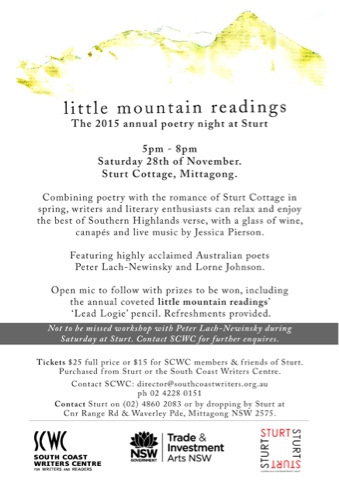
little mountain readings 2015

Can't wait for another great little mountain readings!

This year Peter Lach-Newinsky and Lorne Johnson are our feature poets. As always there will be drinks, canapés, live music, book sales and an open mic.

This year's event is on the 28th of November, from 5-8pm, at Sturt, Mittagong.


Friday, January 2, 2015

A New Year and finally taking action on some challenges I've been wanting to do...

The New Year, a time for new reading and writing challenges...

  • I have challenged myself to tweet a poem or line of poetry everyday @Rhi1988
  • I have set a reading challenge on GoodReads - 50 books read in 2015
  • I am also taking on the 2015 Australian Women Writers Challenge, which was set up to help overcome gender bias in the reviewing of books by Australian women. The challenge encourages avid readers and book bloggers, male and female, Australian and non-Australian, to read and review books by Australian women throughout the year. My aim is to read 6 books by Australian women – reviewing at least 4. Find out more about this challenge at @Auswomenwriters #aww2015 http://australianwomenwriters.com


Sunday, October 26, 2014

Little Mountain Readings - Poetry Workshop


Saturday 15 November, 10.00 am–1.00 pm – Ron Pretty will lead a poetry workshop, Drafting: A Creative Process, at Sturt Cottage, Mittagong. 

Participants will explore ways of developing a first draft into a fully crafted poem. The workshop will explore the creative aspects of the process, including line breaks, language, imagery and structure. 

Participants are asked to bring several of their current poems. 

Fees (including tickets for the Little Mountain Readings in the afternoon) are $85 full fees, $65 Friends of Sturt and SCWC members and $45 for under 18s. 

Bookings essential on (02) 4860 2083 (Sturt Cottage). Information on (02) 4228 0151(South Coast Writers’ Centre).

Friday, October 24, 2014

Little Mountain Readings 2014


Saturday 15 November, 5.00 pm–8.00 pm – Little Mountain Readings will present acclaimed local poets Jessica Raschke and Mark Tredinnick, alongside poets Peter Bakowski and Ron Pretty at Sturt Cottage, corner Range Road and Waverley Parade, Mittagong. 

Bring along your poems! Open mic with book prizes and the inaugural lead logie (LMR pencil) to be won. 

Refreshments provided. 

Bookings from the South Coast Writers’ Centre at director@southcoastwriters.org.au or from Sturt Cottage on (02) 4860 2083. $25/$15 (SCWC members and Friends of Sturt Cottage).

Wednesday, October 8, 2014

Books I have read - Navigation by Judy Johnson

A trade with my dad (we both had accidentally purchased books we already owned) rewarded me with a copy of Navigation by Judy Johnson.

The blurb states that: "Navigation contains poems that are short, sharp pieces drawn from her abiding concerns with family, death, and love". As I sat at Central train station reading her explorations of these human concerns I felt that the bustling of life around me was the ideal setting to get lost in Johnson's words.

'Paper Dolls' is an honest scene from a childhood, exploring the innocence of youth and the conflict that can occur in adult relationships. I remember paper dolls and paper bikinis from my own childhood, the concentration and care needed to pop all of the pieces out and neatly fold the tags so that the 2D figures could be as glamorous as their glossy haired barbie doll cousins. Through her description of the attention given to these dolls Johnson explores the child's emotional response to the sound of fighting from the next room:
I push hard on the perforations.
                         She comes away in two pieces.

Johnson writes poignant images, such as: "I remember the ground / dog-nose damp beneath my feet", capturing the imagination of a child and the sometimes uncomfortable relationship between father and daughter in her poem 'A Month Before my Father Died'.

A poem that resonates with me is 'At the Temple of Sisters'. Someone close to me has been recently diagnosed with cancer and in this poem Johnson describes the cruelness of the disease:
But snares and exorcisms don't work. 
There is nothing to offer your cancer
that it doesn't already have.

Johnson's longer poems in this collection are historical narratives of whalers, a whaler's wife and the Tuniit people of the Antarctic. Here is a harrowing description of doing the laundry on a whaling vessel from her long poem 'A Whaler's Wife at Sea':
...After they are dragged 
back in I sew the body-eaten ghosts
of drowned sailors with thick twine 
onto the strung line.

Warrick Wynne has written a review of Navigation which can be found here. He discusses the diversity of poems and the four parts within the collection, stating that: "[he] found it a little difficult to find the centre of it all, or something like the true voice, if indeed that’s the quest. The book is diverse and moves from the past to the present and back again fluently and is as comfortable with the story as the lyrical moment". For me the centre of the collection is this theme of family, death and love.

I agree with Wynne that the first section, 'Ties', contains the strongest poems of the collection. These poems delve into difficult and sometimes uncomfortable emotions and display an impressive control of language. 'Cannas' is a perfect example of Johnson's rich imagery and description of the external world, alongside an exploration of our 'inner worlds' that Peter Boyle has praised her for. She captures the flowers, their "Garfield-orange, / fresh-wound red, / lemon-spread yellow" colouring and their "elastic javelin" stems. At the same time, she writes of the complexities of coping with cancer, "terminal clusters" that "flows like heredity /through my dreams".

To purchase a copy of Navigation visit 5 Island Press here.

Johnson's most recent book Stone Scar Air Water can be purchased here.  

Tuesday, July 29, 2014

Wollongong Writers Festival

I'm thrilled to be able to promote the Wollongong Writers Festival, an exciting new enterprise that began successfully last year. Congratulations Chloe Higgins for doing such a fantastic job organising this festival!

You can find details of the program here http://www.wollongongwritersfestival.com/event/

Friday, July 25, 2014

In interview with Maree Dawes

7264_19878_dawesauthorIn this interview, editor and poet, Rhiannon Hall talks with West Australian poet, Maree Dawes about her writing and its influences and about her verse novel, brb: be right back.

When did you develop an interest in poetry?
I used to write poetry as a child, continued through high school and early days of uni with a small group of friends – most of it very heartfelt and horrible. I did some poetry workshops, mentorships, residencies and uni studies in the nineties and had my first collection published in 2008.
Are you a communal writer? Is it important to you to workshop your writing with other poets?
I have been involved in a number of communal writing projects. one of my favourite projects was one where an artist Beth Kirkland and I had discussions about themes and topics and then did cafe performances where I wrote a page of stream of consciousness writing. Beth used a pencil to strike through most of my words leaving only a few words which she then highlighted with watercolour.  Sounds complicated but the result was two stories, hers and mine.
I really value getting feedback about my work regarding what is or isn’t working, and I get this from the writing group I belong to. A workshopping process where more of the content comes from others is not something I’ve done, I guess unless it’s a shared project I like what appears in the final copy to be my own work.
Who are some of your favourite poets and what is it that has drawn you to their work?
Dorothy Hewett’s poetry – her work was so experimental and feminist – and her poems about the wheat–belt are special to me because we inhabited the same landscape in different generations.
Dorothy Porter – I have to make myself read her work slowly, especially the verse novels. I just want to gobble up those seductive words … but slow reading illustrates again and again how a few words can push out the sky and make whole worlds of experience appear. Robert Grey makes everything come alive, with his perfect word choices and his balance of natural and made environments. Jordie Albiston, because I can only watch in awe at what she does with form – and while I’m watching the form she trips up my heart. Barbara Temperton for her imagery, getting to the emotional centre of things and the perfect length of line. Alvin Pang, to remind me that the city is also a landscape and Caroline Caddy who reminds me that sight is not the only sense.
What an unfair question … this answer could go on all night. I’ve also enjoyed national collections like Australian Love Poems and The Best Australian Poems.

Wednesday, July 16, 2014

Phillip Hall - Sweetened in Coals

Phillip Gijindarraji Hall, Sweetened in Coals

“This book is a stunning achievement.” – Bonny Cassidy


Phillip Hall has long been an antipodean follower of Henry David Thoreau and John Muir. He has worked as a wilderness expedition leader in Australia for many years writing his nature and environmental poetry in his spare time. For over ten years his poetry has been published in numerous literary journals including Antipodes, Meanjin, Overland, Plumwood Mountain, Quadrant and Southerly.

Phillip now works in remote Indigenous education in Borroloola, the Northern Territory’s Gulf of Carpentaria, where he continues to run camping and sports programs designed to teach emotional resiliency, cooperative group learning and safe decision making. He has immersed himself in Indigenous Culture and Story and has been welcomed into Gulf life with the most amazing generosity and warmth. He has been made a Gudanji man; known also by his skin name of Jabala and his traditional or bush name of Gijindarraji where he is a member of the Rrumburriya clan; he is Jungkayi (custodian) for Jayipa.

Wednesday, July 9, 2014

BRB A Verse Novel by Maree Dawes

I just realised that I haven't posted about brb on here. Maree Dawes published this verse novel through Spineless Wonders early this year and between completing uni and starting teaching I forgot to post about the book and my involvement in its publication.

I was thrilled to be contacted early last year by Bronwyn Mehan from Spineless Wonders. She emailed me a copy of the brb manuscript, asking for a manuscript assessment. I was over the moon to have been even considered for such a task. I carefully read and reread the manuscript, compiling a report about how the verse novel was working on a whole and my response to specific poems. Bronwyn was encouragingly pleased with my report and forwarded it to Maree Dawes. These two talented women then asked me if I would be interested in the task of editing the manuscript with Maree. I was really worried that taking on this task would be too much for me, given how busy I was with uni and with my work out the South Coast Writers Centre, but being me, I just couldn't turn down such an exciting and valuable opportunity. 

Although I wrote no poetry of my own last year, I greatly enjoyed discussing word choices, line breaks and the overall plot of brb with Maree Dawes. Maree was open to the opinions of a novice such as myself and we had a bit over 6months worth of emails, Skype chats and many different versions of the manuscript covered in track changes going back and forward between us. I am very pleased with how this verse novel finished up! Maree is a wonderful writer who captured the complexities of relationships, both online and in real life, with all of the angst, lust and compromises that are inevitable. 

Purchase your copy of brb here:

Check out some fabulous reviews of brb on the following blogs and websites:

You can read an interview I did with Maree Dawes, post publication, here:

Here is an interview between a dear friend and talented writer, Maureen Flynn and Maree:

Another interview with Maree Dawes:

Barbara Temperton launched BRB in WA and you can read her speech here:

Here's a link to Maree's website and Facebook page:

Monday, June 30, 2014

Sweetened in Coals

Alan Wearne will launch Phillip Gijindarraji Hall’s first collection of poetry at the University of Wollongong. The collection, sweetened in coals, explores “ways of responding to place; listening to Country in a way that esteems the Traditional Owners and interrogates colonialism’s crooked paths,” Hall said.

Please come along to the foyer of building 25 at Wollongong University on Friday the 4th of July from 4:30-6pm for a discussion and reading.


Saturday, April 19, 2014

sweetened in coals by Phillip Gijindarraji Hall

I am so proud of my dad! Phillip Gijindarraji Hall has had his first poetry book published, sweetened in coals, with Ginninderra Press. This amazing collection has been in the making for a long time, part of it came about as a result of Phillip's Doctorate in Creative Arts at the University of Wollongong.

This is poetry that dances like the brolga: in praise of wading waist deep in the mountain river's 'nourishing brown flow'; of parcelling freshly caught barra in paperbark before 'sweetening in coals'; of a campfire crackling in 'plumes of rising heat'. Hall raises the flag to Indigenous survival, listening to Country in a way that esteems the traditional owners and interrogates colonialism's crooked paths. This is poetry that keeps us sensitively engaged and committed from beginning to end.

'Every day twenty-first century Australia needs urgent corrections to that ongoing virus of phoney patriotism continuing to infect it. The plain-speaking, closely observed poems of Phillip Hall go a mighty long way in tending to that need.' - Alan Wearne

'Hall is a striking imagist, moving us toward a Thoreauean poetic of sauntering and ambient perspective. Sweetened in Coals is a stunning achievement.' - Bonny Cassidy

Phillip will be at the University of Wollongong in July reading poetry from his collection, which will be launched by Alan Wearne. I will post more details about the launch shortly. Thanks in advance to the South Coast Writers Centre and the University of Wollongong for hosting this launch.

To purchase the book visit Ginninderra Press.

Wednesday, January 1, 2014

Hovering into the Australian Literature Scene - Sotto

Happy New Year dear readers. Please visit Australian Poetry's online journal - Sotto - and read my article 'Hovering into the Australian Literature Scene'. http://www.australianpoetry.org/2013/12/11/hovering-into-the-australian-literature-scene/

The article explores my work at the South Coast Writers Centre. I have sadly finished up my job in the office at the Writers Centre, although I will be staying on as a board member and I will continue to run the annual event, Little Mountain Readings. 

It also discusses my challenges and successes as an emerging poet.

Wednesday, November 27, 2013

Little Mountain Readings

I am incredibly excited to be launching the first Little Mountain Readings (LMR) this weekend, in partnership with South Coast Writers Centre and Sturt, supported by Arts NSW. LMR will be a regular poetry event in Mittagong.

The first LMR will take place this Saturday, November 30th, at Sturt Cottage, 6-9pm.

The event will combine poetry with the romantic atmosphere of the cottage, where writers and literary enthusiasts can relax with a glass of wine, canapes and music.

Local poets Ken Challenor, Kerry Miller and Monica Markovina, as well as acclaimed writer Mark Tredinnick will give poetry readings on the night, followed by an open mic session.

Tickets are $25, or $15 for SCWC members and friends of Sturt. For bookings, please contact the South Coast Writers Centre here or call (02) 4228 0151.

Friday, November 8, 2013

Rocket Readings - Today!!

I have just finished my last prac teaching block. I loved it and was sad to leave the school, the supportive staff and the lovable students behind, but I am looking forward to receiving a placement for next year.

In the meantime, I am excited to have more time for my writing and reading!

First up, today I will be reading some of my poetry at the Wollongong City Gallery, for Viva la Gong's Rocket Readings. I am honoured to have been invited to read by the event host, Linda Godfrey! I am also a bit nervous to be reading alongside poetry great, Peter Skrzynecki!


Saturday, July 6, 2013

Poems I have Read - Taint by Grace Nicholls

Henry Louis Gates discusses the use of ‘Black’ vernacular in postcolonial literature as an act of reclaiming language and aligning the speaker with their black heritage, separate from the ‘white’ colonists (1989). ‘Black’ vernacular is used to create a ‘black’/ ‘white’ schism and is often used to highlight the different roles that ‘black’ and ‘white’ played in the process of colonialism and in the slave trade. The title of Grace Nicholls' poetry collection is written in this ‘Black’ vernacular, I is a Long Memoried Woman (1983).

However, Nicholls' poem 'Taint' is not written in this ‘Black’ vernacular. This is possibly to strengthen the theme of the poem, being ‘stolen’ for the slave trade. The speaker has been ‘stolen’ from where they belong. Language is a powerful tool in post-colonial studies, for the reasons that Henry Louis Gates explores, it is used to reclaim culture and heritage. The development of pigeon English and the handing down of this dialect through generations to form a Creole language is an important process to separate the victims of the slave trade from ‘White’ colonial powers and reclaim a cultural distinction.

On looking closer at the poem the theme of being ‘stolen’ for the slave trade becomes more complex. The speaker states that they were ‘stolen’ and ‘traded’ “by men the colour of my own skin”. The use of repetition here, as Nicholls repeats the line “by men the colour of my own skin”, emphasizes the anger the speaker has for this history of being ‘stolen’ by African slave traders. The anger is not being aimed at the ‘white’ slave owners, but at the men of the same "skin" as the speaker. The use of Western phonetics in this poem can be interpreted as a rejection of a connection to the speaker’s African heritage.
But I was stolen by men
the colour of my own skin...

But I was traded by men
the colour of my own skin
traded like a fowl like a goat
like a sack of kernels I was
traded...
Kwabena Akurang-Parry, states that some African states were involved in the trading of African’s from other states in the Atlantic slave Trade (2010). However, in his critique of Henry Louis Gates, he stresses that it is important to not except the viewpoint that “Africans” enslaved “Africans” (Akurang-Parry, K 2010). Akurang-Parry discusses the deployment of “African”, observing that in African history there is a tendency to coalesce into obscurantist (conservative/traditionalist) constructions of identities that allow scholars, for instance, to subtly call into question the humanity of “all” Africans. Whenever Asante rulers sold non-Asantes into slavery, they did not construct it in terms of Africans selling fellow Africans. They saw the victims for what they were, for instance, as Akuapems, without categorizing them as fellow Africans. Equally, when Christian Scandinavians and Russians sold war captives to the Islamic people of the Abbasid Empire, they didn’t think that they were placing fellow Europeans into slavery. This lazy categorizing homogenizes Africans and has become a part of the methodology of African history. It is through this history that Afro-Americans search for, or rebel against an African identity.

The similes in the second stanza illustrate how undervalued the speaker feels as the men trade him/her “for trinkets”. Indeed, African slaves were traded for goods such as glass beads. The use of the punctuation in this stanza, the question mark, creates a tone of disbelief and resentment, disbelief that anyone could trade her life for such little value and resentment at the middle man, who traded lives for trinkets.
But I was traded by men
the colour of my own skin
traded like a fowl like a goat
like a sack of kernels I was
traded
for beads for pans
for trinkets?
Alliteration is also used in this stanza to again highlight that the speaker’s life was reduced to the value of a ‘trinket’. The ‘K’ sound is repeated throughout the stanza: "...traded ‘like’… ‘like’ a ‘sack’ of ‘kernels’… for ‘trinkets’". The line spacing in this stanza is also important in demonstrating the emotion the speaker feels for being traded for something as little as a ‘trinket’. The word ‘traded’ is placed on a line by itself not only to focus the readers to the act of trade that has occurred, but also to symbolise the trade, separating the objects to be traded from the objects they are traded for. The space between “like a fowl like a goat” emphasises the simile of the speaker to these animals. The spacing in the items the speaker was traded for is used to slow that part of the stanza down and draw attention to the simplicity of the items and the resentment that the speaker feels.
What is a Negro slave? A man of the black race. ... A Negro is a Negro. Only under certain conditions does he become a slave. A cotton-spinning machine is a machine for spinning cotton. Only under certain conditions does it become capital. Torn away from these conditions, it is as little capital as gold is itself money, or sugar is the price of sugar. - Marx, Wage Labour and Capital (1847)
Nicholls has used a lot of alliteration in this poem. I have already shown how the letter ‘k’ is repeated to demonstrate the undervaluing of the speaker’s life that happened through the slave trade. Throughout the entire poem there is alliteration of the letter ‘t’. The letter ‘t’ appears to be dictating the themes of the poem as being ‘stolen’ and ‘traded’ by men who are not human, who do not value life, hands ‘turned talons’, the undervaluing of life, being ‘traded’ for ‘trinkets’. The letter ‘t’ takes us down the ‘trail’, the path of the trade, or of the memory of the trade and walks us to the present. ‘It’, the stealing and trading, we cannot ‘forget’, what we refuse to acknowledge in history is still there, it still happened. Finally the ‘t’ brings the reader to the end of the journey as the speaker rinses the ‘taint of treachery’, the history of betrayal and the speaker’s racial heritage. The poem moves away from an Afro-diasporic identity, allowing the speaker to create their own individual identity, which is still dictated by the past.

Monday, May 13, 2013

Red Room Company and Dapto High

Thank you Darcy Moore for promoting my writing on your blog!

I am looking forward to participating in the Red Room Company's project at Dapto High!

Thursday, April 25, 2013

Books I have read - Red Bird by Mary Oliver

I had heard so much of Mary Oliver's writing from Mark Tredinnick,  Monica (Mon) Markovina and Phillip Hall (my Dad).

Mid last year Mon pressed Oliver's collection, entitled Red Bird, into my hands. Mon told me that I had to read it!

It has taken me a while... but finally, I have read the collection. Now that I have finished it, I wish I had of read it sooner. Mark, Mon and Phillip are right, Oliver's poetry is wonderful to read!

I read Oliver's collection in one sitting. That is unusual for me; I generally only tackle about five poems in a sitting.

There is a simplicity to Oliver's poetry. Oliver uses simple language and images, with often a conversational tone, to explore multiple themes.

She frequently writes about nature, as in the title poem 'Red Bird', where she writes of her devotion to birds and her particular admiration of the red bird:
....
Still, for whatever reason—
perhaps because the winter is so long
and the sky so black-blue,

...
I am grateful

that red bird comes all winter
firing up the landscape
as nothing else can do. (1)
The colour and warmth found in this poem is beautiful. Maxine Kumin has described Oliver as a “indefatigable guide to the natural world”. Indeed, as Kumin has identified, Oliver gives a great deal of attention to the natural world within her writing. In the poem 'Red Bird' Oliver paints a picture of the colours found in nature, of the passing of seasons and of the birds.

As well as this celebration of nature, Oliver describes a relationship between that world which we deem to be human and that which we view as animal. There is a human persona within the poem and it is through their eyes that we are viewing the red bird, as they feed all of "God's" birds (The entirety of 'Red Bird' can be read here).

Here we find another dimension to Oliver's poetry, in her exploration of the spiritual world.

One thing that I have enjoyed about Oliver's poetry is that while the spiritual that she explores is a Christian Spirituality, it is often able to be interpreted as spirituality with a little 's'. As it is a non-denominational spirituality that I believe in, I like that her poetry can be interpreted through this lens.

When Mon lent me this book one page had the corner folded over. Mon had marked the poem 'Percy and Books (Eight)'. Oliver has written a series of poems about her dog, Percy, where she again delves into a discussion about the relationship between the so called human and animal world.

Within this particular poem, Oliver humorously represents the relationship between a dog and its owner. The dog in this poem wants to be immersed into the splendor of the world outside, while the owner desires to dally in the world of books.

The poem begins: "Percy does not like it when I read a book" (29). It then describes the dog and the weather and sounds of the natural world, that can be heard from where both dog and owner sit. The owner pleads with the dog: "But Percy, I say. Ideas! The elegance of language!" (29). Without ruining the joke, the dog is not convinced of the value of books.

While the simplicity of Oliver's imagery and language make it easy for a reader, or at least for me, to loose them self in the ideas and pictures that she has captured, is it enough to explore nature as beautiful?

I have had many discussions with Phillip Hall and some with Mark Tredinnick and Mon about just such a question.

In the 21st Century we are being faced with global warming, environmental disasters (both natural and human made), and the endangerment and extinction of various plants and animals. Is it, therefore, enough to celebrate nature and explore how the perceived 'natural' and 'human' world interact, or should representations of nature be exploring the bigger issues of global warming and the threats facing both the natural and human world?

In asking the above questions I am not suggesting that Oliver should necessarily be doing these things with her poetry, or that there is not a place for the celebration of nature in poetry, but I am questioning what is poetry's role in the world?

You can buy a copy of Mary Oliver's Red Bird from Amazon here.

Here is a great interview with Mary Oliver, exploring another of her poetry collections, A Thousand Mornings.

Here are some links to Oliver's poems that can be read, for free, online:
http://www.loc.gov/poetry/180/133.html
http://rinabeana.com/poemoftheday/index.php/category/mary-oliver/
http://www.poetryfoundation.org/bio/mary-oliver#about

Mary Oliver reads three of her poems here.

Saturday, February 23, 2013

Morning Becomes Electric

The South Coast Writers Centre's Poetry Appreciation Group looked at the poetry of Bruce Dawe in our meeting this month. One of the poems that we read and discussed was his 'Morning Becomes Electric'.

The imagery within this poem is amazing and at first appears quite eclectic.

The poem includes metaphors of nature and the hustle of morning traffic, beginning:
Another day
roars up at you out of the east
in an expressway of birds gargling their first
antiseptic song, where clouds are
bumper-to-bumper all the way back to the horizon.
As well as the similes of traffic and nature there is an image of car fumes reminding the speaker of the smell of a friend being cremated. This image made many in our group feel slightly uncomfortable and led to a lengthy discussion about the appropriateness of the image within the context of this poem. The lines that I am referring to run as follows:
the odour of stalled vehicles
wickedly pleasant like an old burning friend,
still whispering to you from the incinerator.
The poem then ends with images of the home, of preparing breakfast and opening the door to door-to-door salesmen:
...its armies, its smoke, its door-to-door salesmen,
... giving you an argument of sorts
before you have even assembled your priorities,
properly unrolled your magic toast
or stepped into the wide eyes of your egg.
For me, this poem is exploring a few things: firstly, and most obviously, the repetitiveness and predictiveness of the everyday; as well as, change and adjustment.

The first of these I don't believe needs any further explanation, the lines from the poem above clearly illustrate the humdrum nature of the everyday that Dawe's has captured.

As for my assertion that the poem is exploring change and adjustment, I feel that Dawe is drawing out the changes that we experience within the everyday. I say 'we' because Dawe addresses "you" or us as readers throughout the poem. That change may be gradual, for example where there was once herds of cattle meandering between fields there may now be a busy road, where during peak hour, cars "bank-up". As the physical landscape changes so to do we, as living organisms. The adjustment or acceptance of the loss of a friend can also be gradual, as we are reminded of a passed friend in the "odour of stalled vehicles".

This poem is satirical, as are many of Dawe's poems, the comments on change and the lack of control that we have over the everyday that can be found within the poem include an element of shock value, as well as a questioning of if and why we would want to have such a tight control over the everyday. The traffic scene of the first two stanzas is crowded and we are all just hanging on, with the gulls, waiting for something newsworthy to occur. Even as we are pulled back into the house in the third stanza, we are still holding on for something more exciting than the 'everdayness' of the door-to-door salesmen. The magic realism of the last two lines, where we are 'unrolling' our toast and 'stepping into' our eggs, is a final illustration of the ridiculousness of the everyday.

To purchase this Bruce Dawe's collection Sometimes Gladness, which this poem can be found in, click here or here. Copies of Sometimes Gladness can also be found cheap at second hand stores.

Saturday, December 22, 2012

Seeking the Sun: Australian Poetry 2012

I came home from work on Thursday to find a copy of the Central Coast Poet Inc.'s anthology Seeking the Sun: Australian Poetry 2012. I flipped the anthology open and scanned through the poets included, there were some great writers represented. Amazingly my name was in there. The anthology includes my poem 'Retirement and a Goat', which I submitted to the Henry Kendall Poetry Award. Thank you to David Musgrave and the team at Central Coast Poets Inc. for including my poem in this collection.

The anthology can be purchased from http://www.amazon.co.uk/Seeking-Sun-Australian-Poetry-2012/dp/1466425369.

Merry Xmas and Happy New Year everyone.